


Lowell has become one of the most attractive communities in Greater Boston for professionals, families, first-time buyers, and investors.
Its historic neighborhoods, growing downtown, strong university presence, and convenient commuter rail access continue to attract new residents every year. As housing costs evolve, many people are asking whether it’s smarter to rent or buy a home in Lowell in 2026.
The answer depends on your finances, lifestyle, and long-term plans. While renting provides flexibility, buying offers the opportunity to build equity and establish financial stability over time. Understanding today’s market conditions can help you make the right decision.
Deciding to Rent or Buy a Home in Lowell
Deciding to rent or buy a home in Lowell depends on your long-term goals. While renting offers flexibility and lower upfront costs, buying protects you from rising rent prices and builds permanent equity. Analyzing the current Lowell housing market in 2026 helps clarify which option best suits your budget.

Evaluating Lowell Real Estate Costs for Buyers
The Path to Equity
Buying a home is often one of the largest financial decisions a person will make. Understanding Lowell real estate costs allows buyers to determine whether homeownership fits their current budget and future goals.
Like much of Middlesex County, Lowell remains a competitive housing market. Buyers should be prepared for several upfront expenses, including:
- Down payment
- Closing costs
- Home inspection fees
- Appraisal fees
- Moving expenses
Although these initial costs can seem significant, homeownership creates long-term financial value.
Every mortgage payment helps build equity rather than simply covering housing costs. Over time, homeowners benefit from paying down their loans while potentially gaining from property appreciation.
Whether purchasing a historic Victorian in Belvidere, a single-family home in Pawtucketville, or a modern condominium near downtown, buyers gain the advantage of investing in an appreciating asset instead of paying rent indefinitely.
For households planning to remain in Lowell for at least five to seven years, buying often becomes more financially advantageous than renting.
Tax Benefits and Stability
Homeownership also offers financial advantages beyond equity.
Qualified homeowners may benefit from federal tax deductions for mortgage interest and eligible property taxes, depending on their financial situation and current tax laws. Consulting a tax professional can help determine individual eligibility.
Another major benefit is payment stability. With a fixed-rate mortgage, monthly principal and interest payments remain consistent throughout the loan term.
While property taxes and insurance can change over time, homeowners generally avoid the annual rent increases that renters often experience. That predictability makes long-term budgeting significantly easier.

The Realities When You Rent Lowell, MA Apartments
Flexibility and Maintenance Freedom
Choosing to rent Lowell, MA apartments remains an excellent option for many residents. Renting provides flexibility that homeownership simply cannot match. This is especially valuable for:
- Graduate students
- Young professionals
- Medical workers
- Employees with uncertain job locations
- Individuals relocating within a few years
Popular rental areas include downtown Lowell, the Canal District, and neighborhoods surrounding UMass Lowell.
Renters also avoid many of the responsibilities associated with owning property, including:
- Roof repairs
- Heating system replacement
- Plumbing emergencies
- Snow removal
- Lawn maintenance
- Property taxes
- Most structural maintenance
Unexpected repair costs that can total thousands of dollars typically remain the landlord’s responsibility.
The Cost of Convenience
The convenience of renting comes with tradeoffs. Monthly rent payments do not build ownership in a property. Once rent is paid, that money cannot be recovered through resale or appreciation.
Renters are also exposed to changing market conditions. Lease renewals may include rent increases based on local demand, operating costs, or inflation. In a city with strong housing demand like Lowell, annual rent increases can gradually make renting more expensive over the long term.
For renters planning to remain in the area for many years, purchasing may ultimately provide greater financial stability.

Analyzing the Lowell Housing Market 2026
Market Inventory and Demand
The Lowell housing market 2026 continues to experience healthy demand.
Several factors contribute to the city’s popularity:
- Proximity to Boston via Interstate 495 and the MBTA Commuter Rail
- Growing employment opportunities throughout Middlesex County
- UMass Lowell’s expanding student and faculty population
- Continued downtown redevelopment
- More affordable pricing than many neighboring Boston suburbs
These factors continue to support home values and maintain steady buyer interest. Inventory remains relatively limited compared to demand, creating competition for well-priced homes.
While mortgage rates continue to influence affordability, many buyers are choosing to purchase sooner rather than risk higher home prices in future years. Others may decide to rent temporarily while saving for a larger down payment or waiting for more favorable financing conditions.
There is no universal answer—only the option that best aligns with your financial situation.
Using a Rent vs Buy Calculator in Lowell
One of the most effective ways to compare your options is by using a rent vs buy calculator Lowell residents can customize with local figures.
A quality calculator should include:
- Purchase price
- Down payment
- Mortgage interest rate
- Property taxes
- Homeowners insurance
- Maintenance costs
- HOA fees, if applicable
- Expected home appreciation
- Average annual rent increases
- Investment returns on savings
Comparing these costs over five, ten, or even thirty years provides a much clearer financial picture than looking only at monthly payments.
Many prospective buyers are surprised to discover that the total cost difference between renting and buying narrows considerably over longer time horizons.
Lowell Renting vs Buying 2026 Comparison Table
| Lifestyle Factor | Buying a Home in Lowel | Renting in Lowell |
|---|---|---|
| Upfront Costs | High (Down payment, closing fees) | Low (First, last, security deposit) |
| Monthly Payment | Stable (Fixed-rate mortgage) | Variable (Subject to annual increases) |
| Wealth Building | High (Builds equity over time) | None |
| Flexibility | Low (Tied to the property) | High (Easy to relocate after lease ends) |

Make a Data-Driven Decision
The decision between Lowell renting vs buying 2026 ultimately comes down to your personal goals.
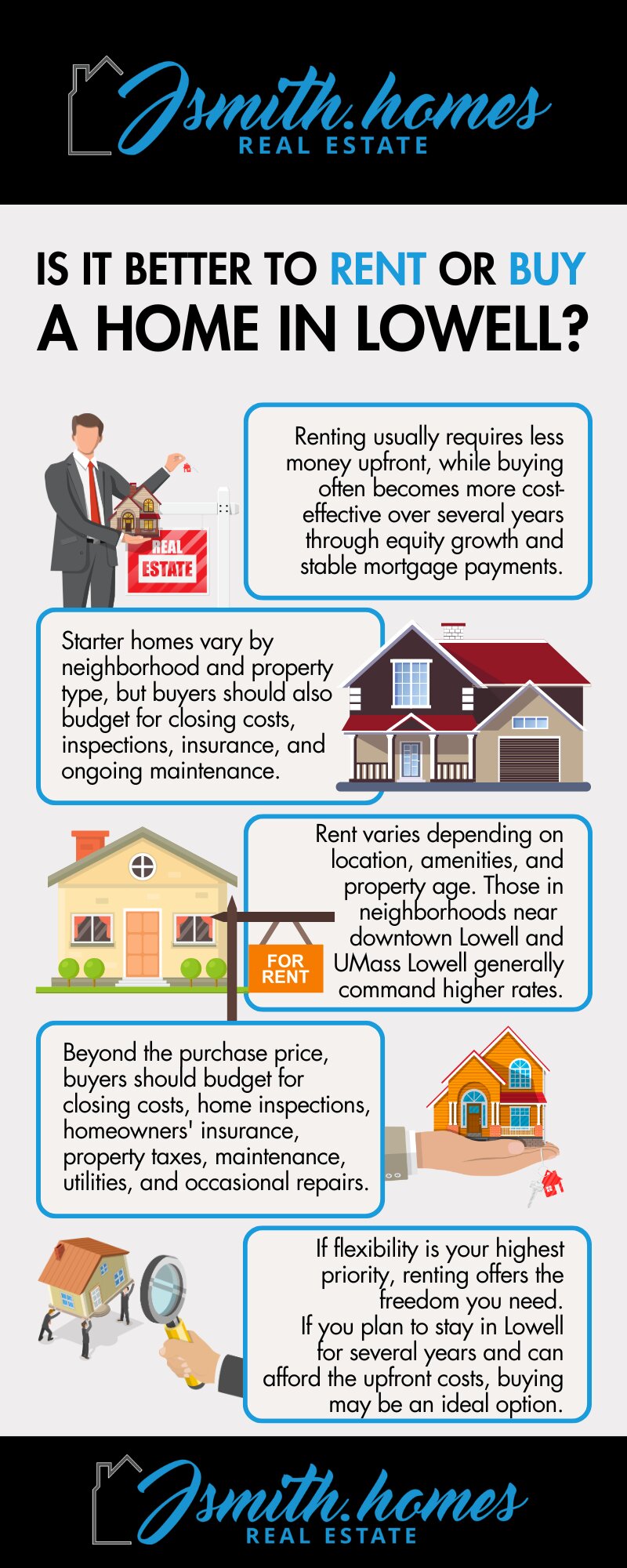
If flexibility is your highest priority, renting may provide the freedom you need.
If you plan to stay in Lowell for several years and can comfortably afford the upfront costs, buying may position you to build long-term wealth while protecting yourself from rising rental costs.
Before making your decision:
- Evaluate your monthly budget.
- Estimate your upfront buying costs.
- Review current mortgage rates.
- Monitor local housing inventory.
- Compare rental prices.
- Use a rent vs. buy calculator with realistic assumptions.
By carefully evaluating Lowell real estate costs, understanding the Lowell housing market 2026, and comparing the long-term financial impact of both options, you’ll be in a much stronger position to choose the path that supports your future.
Whether you decide to rent Lowell MA apartments for flexibility or rent or buy a home in Lowell to build equity, Lowell continues to offer excellent opportunities for residents seeking a vibrant, well-connected community.
Having expert guidance can make the decision much easier. I am here to help you evaluate your budget, timeline, and long-term goals so you can confidently navigate today’s Lowell housing market.
For personalized advice and answers to your real estate questions, feel free to give me a call at 781-531-8988 or email jeremy@jsmith.homes. Reach out today to discuss your options and take the next step toward finding the right home in Lowell.
Frequently Asked Questions
Is it currently cheaper to rent or buy a home in Lowell?
The answer depends on mortgage rates, home prices, and how long you plan to stay. Renting usually requires less money upfront, while buying often becomes more cost-effective over several years through equity growth and stable mortgage payments.
What are the average Lowell real estate costs for a starter home in 2026?
Starter homes vary by neighborhood and property type, but buyers should budget not only for the purchase price but also for closing costs, inspections, insurance, and ongoing maintenance. Working with a local real estate professional provides the most accurate pricing for current market conditions.
How much is the average rent Lowell, MA landlords charge for a two-bedroom apartment?
Rental rates vary depending on location, amenities, and property age. Two-bedroom apartments in desirable neighborhoods generally command higher rents, especially near downtown Lowell and UMass Lowell.
Will the Lowell housing market in 2026 favor buyers or sellers?
The market remains relatively balanced but competitive. Limited inventory and continued buyer demand support home values, although affordability continues to be influenced by mortgage interest rates.
Does a rent vs buy calculator Lowell factor in property taxes?
Yes. Most comprehensive calculators include property taxes, homeowners’ insurance, maintenance costs, mortgage interest, expected appreciation, and projected rent increases to provide a more accurate comparison.
How does commuter rail proximity affect Lowell renters' vs. buyers' 2026 decisions?
Homes and apartments near MBTA Commuter Rail stations often experience stronger demand due to easier access to Boston. Buyers may benefit from stronger long-term property values, while renters may pay premium rates for convenient commuting.
What hidden costs should I expect when buying a home in Lowell, MA?
Beyond the purchase price, buyers should budget for closing costs, home inspections, moving expenses, homeowners insurance, property taxes, maintenance, utilities, and occasional repairs such as roofing, HVAC systems, or appliances.