


In Lowell, MA, property taxes are often one of the largest recurring expenses for homeowners in the city. Yet, many residents overpay simply because they miss deadlines, overlook exemptions, or fail to challenge an inaccurate assessment.
The good news is that the City of Lowell offers several legal, effective ways to reduce your property tax bill if you know where to look.
This guide walks you through the most important strategies—from understanding your tax bill to applying for abatements and exemptions.

Understanding Your Bill: The Lowell Tax Rate
Before you can start lowering your taxes, it’s crucial to understand how they are calculated.
Lowell uses a split tax rate system, which means residential and commercial properties are taxed at different rates.
Residential vs. Commercial
In Lowell, residential properties are taxed at a lower rate—approximately $11.48 per $1,000 of assessed value—while commercial and industrial properties face a higher rate.
Knowing this helps homeowners understand the base of their Lowell MA real estate tax bill and compare it with similar properties in the city.
The Assessment Cycle
Your property tax bill is based on the assessed value of your home as of January 1st of the previous year, not necessarily what your home is worth today.
This means that even if the housing market fluctuates, your taxes are tied to the most recent official assessment, which is why keeping tabs on your property’s assessed value is so important.

The Abatement Process: Challenging the Value
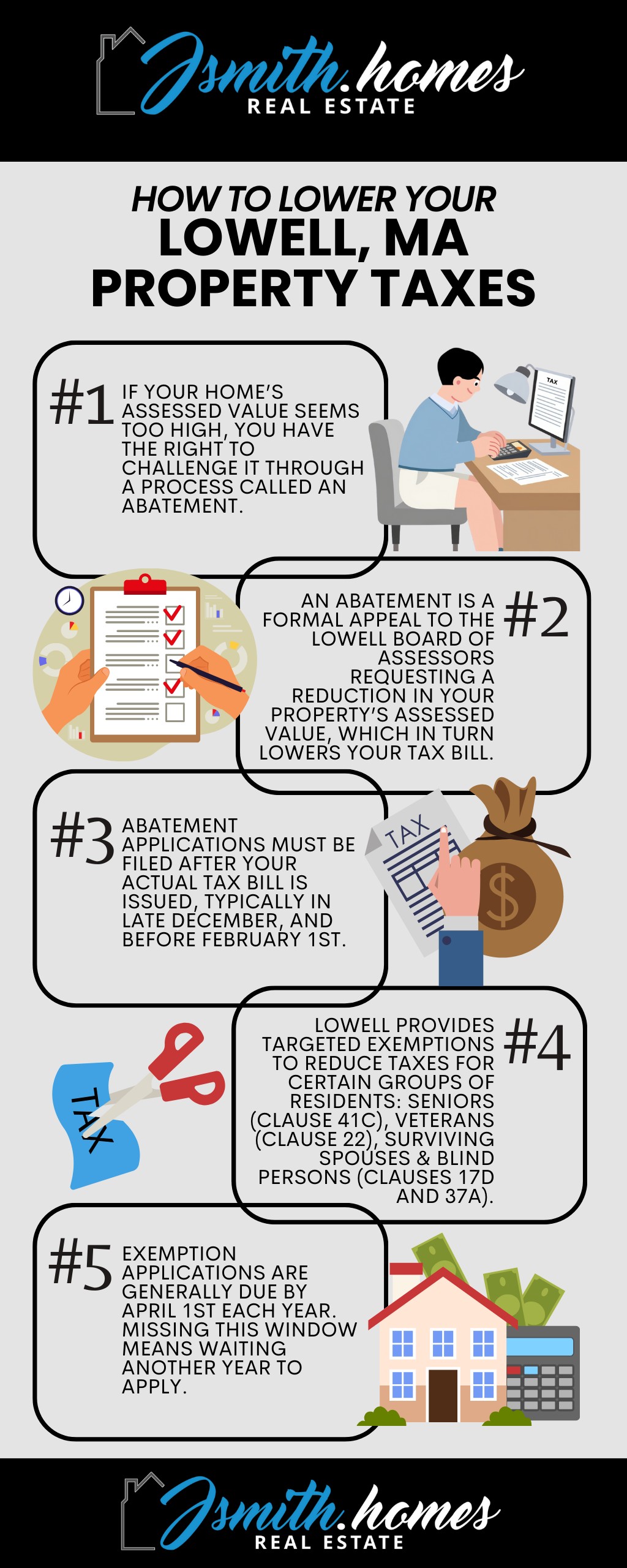
If your home’s assessed value seems too high, you have the right to challenge it through a process called an abatement.
What is an Abatement?
An abatement is a formal appeal to the Lowell Board of Assessors requesting a reduction in your property’s assessed value, which in turn lowers your tax bill.
Valid Reasons to File
- Overvaluation: Your home is assessed for more than its fair market value.
- Disproportionate Assessment: Your property is valued higher than similar homes in your neighborhood.
- Data Errors: Mistakes on your property record card, such as an incorrect number of bedrooms, bathrooms, or total square footage.
The Hard Deadline
Abatement applications must be filed after your actual tax bill is issued, typically in late December, and before February 1st. Applications submitted late are automatically denied, so mark your calendar and act early.

Statutory Exemptions for Specific Groups
Lowell also provides targeted exemptions to reduce taxes for certain groups of residents.
Seniors (Clause 41C)
Homeowners over 65 with limited income and assets may qualify for a $1,000 reduction in their property tax bill. Income limits are set annually, so it’s important to check the latest requirements.
Veterans (Clause 22)
Veterans with a service-connected disability of 10% or more can qualify for an exemption. The benefit ranges from a modest $400 deduction up to a full exemption for paraplegic veterans.
Surviving Spouses & Blind Persons (Clauses 17D and 37A)
Specific exemptions exist for surviving spouses of veterans and individuals who are legally blind.

Deadline
Exemption applications are generally due by April 1st each year. Missing this window means waiting another year to apply.
The Senior Tax Work-Off Program
For seniors looking for another way to reduce taxes, Lowell offers the Senior Tax Work-Off Program.
Volunteering for Credit
Seniors aged 60+ can volunteer their time in city departments—such as the library, recreation department, or public works—and earn a property tax credit.
Depending on hours worked and available positions, seniors can receive up to $1,500 in credits per fiscal year.
Eligibility
With residential exemption eligibility, income limits apply and applications are usually accepted in late summer or early fall. It’s a great way for active seniors to contribute to the community while reducing their tax burden.
Reviewing Your Property Record Card
Accuracy in your property’s assessment is critical. Lowell residents can request a copy of their field card from the Assessor’s database, which includes detailed information about their home.
Accuracy Matters
Double-check that square footage, number of bedrooms and bathrooms, lot size, and other key details are correct. Mistakes here can lead to over-assessment.
Condition Issues
Deferred maintenance, such as a leaky roof, cracked foundation, or outdated heating system, can affect your home’s assessed condition code. Documenting these issues with photos or repair estimates can help support an abatement request.
Frequently Asked Questions
When is the absolute deadline to file for a property tax abatement in Lowell?
February 1st, following the issuance of your tax bill. Late applications are automatically denied.
Can I apply for more than one exemption if I qualify for multiple categories?
Yes, it is possible, but each exemption must be applied for separately and approved individually.
How does the City of Lowell determine the “fair market value” of my home?
The city uses sales data from comparable properties in your neighborhood and applies standard valuation techniques to determine your property’s assessed value.
Is the Senior Tax Work-Off program taxable income?
No, the program provides a credit against your property tax bill, not taxable income.
If my abatement is denied by the Board of Assessors, what is the next step?
You can appeal the decision to the Massachusetts Appellate Tax Board within the designated timeframe, usually 3 months from the denial notice.
Do I need to reapply for my veteran or senior exemption every year?
Some exemptions, like certain veteran clauses, may be permanent, but most senior exemptions require annual reapplication to confirm income eligibility.
What happens to my tax bill if I add an addition or finish my basement?
Your home’s assessed value will likely increase, which could raise your property taxes. Always report major renovations promptly to avoid penalties, and consider how the improvement impacts your taxes.
Key Takeaway
When it comes to lowering your Lowell property taxes, timing is everything. Missing critical deadlines—February 1st for abatements and April 1st for exemptions—means you’ll have to wait a full year for relief.
Start by reviewing your assessment annually, checking your property record card for errors, exploring exemptions, and filing early. With careful attention and proactive action, you can keep more of your hard-earned money in your pocket without breaking any rules.
If you happen to be in the market to buy a home in Lowell, MA, give me a call today at 781-531-8988 or send me an email to schedule an appointment.